Average Reviews:

(More customer reviews)Are you looking to buy The Future of Chinese Capitalism: Choices and Chances? Here is the right place to find the great deals. we can offer discounts of up to 90% on The Future of Chinese Capitalism: Choices and Chances. Check out the link below:
>> Click Here to See Compare Prices and Get the Best Offers
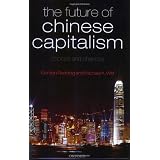
The Future of Chinese Capitalism: Choices and Chances ReviewThis book starts with the premise that the elements of a business system consists of three key layers: culture, institutions, and business structures. The business system of a society is deeply embedded in the fabric of institutions and institutions are in turn shaped by culture.Redding and Witt suggest that readers cannot comprehend the evolutionary path of today's business system in China without knowledge of the influence of Confucianism. Confucianism is a code of conduct that places family as the core unit and the state a superfamily of the society within which the rights of an individual are subordinated to family interests. The state could invade in personal private space and its supporting apparatus consisists a group of Confucian scholars in pre-1949 period and members of the Communist party after 1949. In coordinating economic behaviour and exchange, business persons tend to restricts themselves to extended families, friends, and clans due to poverty of institutional trust. Within companies, paternalistic culture is prevalent and decision-making are top down so that there is low level of upward communication in the managerial process.
Redding and Witt believe that overseas Chinese firms have played a significant role in China economy in terms of massive investments and also being intermediaries between China and the developed countries (P.61). After Asian financial crisis of 1997/1998, they have adjusted into a new hybrid form in management but ownership control remains in the hands of founding entrepreneurs and their family members. In discussing on business system of China, they divide it into three organisational forms including the state-owned sector, the local corporates, and the private sector. State-owned firms are large, bureaucratic, and capital intensive but very inefficient in productivity and asset management. With the arrival of MNEs in the China market, they have looked less competitive due to poor technical innovation, inability to manage the value chain across an organisation's components, and unattractive reward system. Therefore, China's future economic growth is likely to depend on firms in the local corporates and the private sector (P.101). Although most of them are small in size, they are very successful in mass production of mid- or low-technology products and are very adaptable in conditions of low level of institutional trust in China. In order to transcend the limitations of small size, technical know-how, and financial resources, they undertake businesses within a web of connected firms and with high flexibility of market response (P.143).
Redding and Witt make a detailed comparison of business system of China with other four economic powerhouses including US, Germany, Japan, and Korea and see what kind of capitalism is likely to evolve in China's future economic growth. To them, the shareholder-value-oriented management, separation of ownership and control, and strong R&D capability that are prevalent in the US seems unlikely to occur in China. Japan's employee-centric stakeholder value, delegation and interdependence within the firm, and societal coordination can also hardly apply to the Chinese context. Nor the form of collaborative capitalism in Germany will evolve in China's future economic growth. However, the `Chaebol' form in Korea (P.207) is seemed to jibe well with the Chinese context.
According to them, the future success of Chinese capitalism will be severely handicapped by three issues. First, US government might take measure to contain China's rise. Second, the one-child policy since 1979 will have an adverse impact on its economic development. Third, the absence of institutional trust and the emergence of middle class require policy-makers to need to change. If the business system of China can continue to be competitive in the 21st century, Gordon and Witt conclude that the Shanghai model that favours the idea of reforming state-owned firms should be shifted to Hong Kong/Guangzhou model in which policy-makers can formulate long-term industrial policies for the growth of private firms to become mammoth ones at world standards of efficiency. (P.220).
In conclusion, this book offers a systematic exploration of the business system of China and is relevant to scholars, policy-makers, and business persons who intend to 'think hard' about it from a more holistic or macro-level perspective.The Future of Chinese Capitalism: Choices and Chances Overview
Want to learn more information about The Future of Chinese Capitalism: Choices and Chances?
>> Click Here to See All Customer Reviews & Ratings Now

0 comments:
Post a Comment