Average Reviews:

(More customer reviews)Are you looking to buy
McGraw-Hill's GMAT? Here is the right place to find the great deals. we can offer
discounts of up to 90% on
McGraw-Hill's GMAT. Check out the link below:
>> Click Here to See Compare Prices and Get the Best Offers
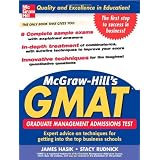
McGraw-Hill's GMAT ReviewI reviewed this book for the book with no CD-ROM. Since that's a mistake, I should also review it here.
This book is filled with errata. Not just typos or 'oops, I missed that'-errata, but huge misunderstandings of mathematics and, to a lesser extent, grammar.
Some of my favorites:
a) Is r prime?
(1) [something]
(2) r^2 = 17^2
Answer from CD: (2) is insufficient because r could be 17 or -17 and each is prime.
Real answer: Prime numbers are integers > 1 as we all learned in 5th grade or something. This isn't just a little mistake. If negative numbers were prime then 'The Fundamental Theorem of Arithmetic' (that natural numbers are either prime or UNIQUELY factorable into the product of primes) wouldn't be true. Think the authors of a book teaching math ought to know about 'The Fundamental Theorem of Arithmetic'?
b) A cylindrical barrel is filled with a chemicals. "If the chemicals weigh 0.9 kg/l what is the total mass of the chemical in the barrel?"
(1)[something]
(2)[something else]
Answer from CD: [verbatim] Neither statement is sufficient, either alone or in combination because althought the statements can be combined to give the diameter [and height] of the barrel, there is no way to determine the density of the chemical in question, so there is no way to determine exactly how much of the chemical will fit in a barrel of that size
Real answer: I almost fell off my chair laughing. Somehow the authors remembered from high school physics that there is something different between mass and weight and then got confused. There is a little wording problem here because kg can be a unit of mass or weight and they're mixed here. However, anywhere on Earth the 1 significant digit figure means you can mix up mass and weight with no problem. If 0.9 kg/l is not a density, I don't know what a density looks like. Perhaps the authors didn't know that 1000 liters = 1 Cubic meter (fourth grade?).
c) [Drawing of 4x4 grid of city blocks of equal length]
How many different routes can Casey the cabdriver take from the Northwest corner to the SouthEast corner that travel the shortest possible distance?
Answers: A.9 B.11 C.14 D.16 E.18
Answer from CD: E. There are 18 routes that drive '3 blocks down and 3 blocks right. If these possibilities are expressed as D and R, the total possibilities are: DDDRRR, DDRRRD, DDRRDR,....'
Real answer: Casey needs to go three blocks South (S) and three blocks East (E) so the number of routes are the number of ways of arranging three "S"'s in 6 spots and then filling in the open spots with "E"'s. This is 6 choose 3 = 20, which has the decided weakness of not being one of the answers. Of course for fun, you can find which routes the authors missed in their "exhaustive" list (they are: DRRDDR and RDDRRD). Is this the way the authors want you to solve these problems? What if there were 10 city blocks? BTW - The answers to these city block questions are always numbers from Pascal's triangle and usually near the top and the middle, so if you have to guess it's very likely to be 10, 15, 20, or 35. None of the choices on the exam are reasonable numbers from Pascal's triangle.
d) [Bunch of stuff that says a scientist sampled 20,000 fruit flies and found that 6 of them had a genetic mutation] [verbatim] "How many fruit flies would the scientist need to include in his experiment in order to have a reasonable expectation of locating approximately 50 fruit flies with the mutation in question?"
Answer from CD: 250,000 because 1/5000 has the mutation.
Real answer: I haven't a clue. "Reasonable expectation" is not a mathematical term. "Expectation" is a mathematical term that ought to be used here, but the question needs to be phrased more technically than the GMAT's require. If I appeal to the Central limit theorem here, I have approximately a 50% chance of having at least 50 mutations if I sample 250,000 fruit flies. Is that a "reasonable expectation"? Who knows?And I could go on and on and on (the verbal ones are not as bad, but still pretty bad).
The book says 'Aim for the High 600's!' on the cover. Personally, I think that is not a very high aspiration. If you buy this book and try to learn from it, your ceiling will move from 800 to the high 600's (which is probably the ability level of the authors). Want to spend $30 and some time doing that? I think you would be nuts to buy this book when there are a bunch of pretty good alternatives out there.
McGraw-Hill's GMAT OverviewWant to learn more information about
McGraw-Hill's GMAT?
>> Click Here to See All Customer Reviews & Ratings Now