Average Reviews:

(More customer reviews)Are you looking to buy Harvard Business Review on Breakthrough Thinking? Here is the right place to find the great deals. we can offer discounts of up to 90% on Harvard Business Review on Breakthrough Thinking. Check out the link below:
>> Click Here to See Compare Prices and Get the Best Offers
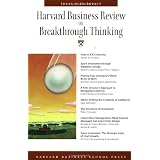
Harvard Business Review on Breakthrough Thinking ReviewThis is one in a series of several dozen volumes which comprise the "Harvard Business Review Paperback Series." Each offers direct, convenient, and inexpensive access to the best thinking on the given subject in articles originally published by the Harvard Business School Review. I strongly recommend all of the volumes in the series. The individual titles are listed at this Web site: www.hbsp.harvard.edu. The authors of various articles are among the world's most highly regarding experts on the given subject. Each volume has been carefully edited. Supplementary commentaries are also provided in most of the volumes, as is an "About the Contributors" section which usually includes suggestions of other sources which some readers may wish to explore. In this volume, the reader is provided with eight articles. Here is a selection of brief excerpts from the executive summaries with precede each of three:"....managers need to understand that creativity has three parts: expertise, the ability to think flexibly and imaginatively, and motivation. Managers can influence the first two, but doing so is costly and slow. It would be far more effective to increase employees' intrinsic motivation....To that end, managers have five levers to pull: the amount of challenge they give employees, the degree of freedom they grant around process, the way they design work groups, the level of encouragement they give, and the nature of the organizational support." (Introducing Teresa M. Amabile's "How to Kill Creativity")
"Some innovations spring from a flash of genius [but] most result from a conscious, purposeful search for opportunities. For managers seeking innovation, engaging in disciplined work is more important than having an entrepreneurial personality....[According to Drucker, the major sources of opportunities include] unexpected occurrences, incongruities of various kinds, process needs, or changes in an industry or market,...demographic changes, changes in perception, or new knowledge." (Introducing Peter F. Drucker's "The Discipline of Innovation")"[Having studied more than 30 of the largest international corporations, Kim and Mauborgne found that]....the difference between the high growth companies and their less successful competitors was in each group's assumptions about strategy....Managers of the high-growth companies followed what [Kim and Mauborgne] call the logic of value innovation....Many companies let competitors set the parameters of of their strategic thinking; value innovators do not use rivals as benchmarks. Rather than focus on the differences among customers, value innovators look for what customers value in common. Rather than view opportunities through the lens of existing assets and capabilities, value innovators ask, What if we start anew?" (Introducing W. Chan Kim and Renee Mauborgne's "Value Innovation: The Strategic Logic of High Growth")
In the other five articles, Dorothy Leonard and Jeffrey F. Rayport explain how to spark innovation through what they call "empathetic design"; Leonard and Susaan Straus explain how to "put your company's whole brain to work"; Eileen Morley and Andrew Silver propose taking what they call "a film director's approach" to managing creativity; in a case study, Suzy Wetlaufer examines what is stifling creativity at CoolBurst, a fictitious Miami-based fruit juice company; and Richard K. Lester, Michael J. Piore, and Kamal M. Malek introduce their concept of "interpretative management," explaining what general managers can learn from design.
Granted, because several of these articles were published years ago, some of the material in this volume is understandably somewhat dated but the core concepts are solid and remain relevant to all organizations, regardless of size or nature. Those who share my high regard for this volume are urged to check out others in the "Harvard Business Review Paperback Series." Also, Michael Michalko's Cracking Creativity, Doug Hall's Jump Start Your Business Brain, and Tom Kelley's The Art of Innovation as well as Barry J. Nalebuff and Ian Ayres's Why Not?Harvard Business Review on Breakthrough Thinking Overview
Want to learn more information about Harvard Business Review on Breakthrough Thinking?
>> Click Here to See All Customer Reviews & Ratings Now

0 comments:
Post a Comment