Average Reviews:

(More customer reviews)Are you looking to buy The Drucker Difference: What the World's Greatest Management Thinker Means to Today's Business Leaders? Here is the right place to find the great deals. we can offer discounts of up to 90% on The Drucker Difference: What the World's Greatest Management Thinker Means to Today's Business Leaders. Check out the link below:
>> Click Here to See Compare Prices and Get the Best Offers
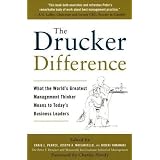
The Drucker Difference: What the World's Greatest Management Thinker Means to Today's Business Leaders ReviewA humanistic approach to management points out how people play essential roles in an organization's life. This theme is followed in The Drucker Difference. The book is a compendium of chapters that all tie onto at least one thread of Drucker's wisdom. Drucker died in 2005. Drucker saw himself as a social ecologist who cares about the larger societal roles played by companies and the individuals within them. He developed a humanistic theory of management and government that promotes having organizations in which people matter.The publication of The Drucker Difference is part of a celebration of the hundredth anniversary of Drucker's birth. Each chapter is written by a different author, or pair of authors, who are connected to the "Drucker and Ito Graduate School of Management" in Claremont, California, where Peter Drucker taught for 30 years.
The chapters were originally written for sessions in a course at the School of Management. The topics have a wide scope: intellectual capital, social responsibility, corporate governance, strategy, nonprofits, business environment, leadership, human resources, marketing, economics, pension funds, and managing in the government sector. In each chapter, the authors initially connect their work to Drucker's thinking, and, then, expand the topic to include where they are today and the growth of knowledge that they foresee in the future.
Ethics and the Liberal Arts
In the first chapter, Karen Linkletter and Joseph Maciariello connect management to the liberal arts. Drucker was annoyed that many business leaders only worship greed and profits, nothing else. One result is excessive executive pay. Linkletter and Maciariello confirm Drucker's vision of a need for finding a moral basis for business in the liberal arts. The liberal arts help people gain an understanding of human nature, cultural and communal values, and morals. By studying the liberal arts, business leaders can develop ethics that are based on society's moral values of right and wrong.
Knowledge Workers
Drucker was one of the first writers to use the term "Knowledge Workers" for those who do work that requires the contribution of intellectual capital. Drucker perceived the existence of problems with knowledge worker productivity, but did not resolve them. In their chapter, Jeremy Hunter and J Scott Scherer recommend improving knowledge worker productivity through ceasing multi-tasking, and commencing meditation and mindfulness. The latter directs one to be more aware of one's emotions, beliefs, and actions. The end result is that one tends to abandon nonproductive behaviors.
Craig Pearce points out how shared leadership is essential to effectively employ knowledge workers. The impact of shared leadership is greater with teams that manage change, virtual groups that are geographically dispersed, and top management teams. Pearce recommends adopting "Empowering Leadership" for dealing with knowledge workers. It favors having employees influence each other over top-down command and control. An empowering leader is more like a cheerleader whose goals is to get the employees to interact and build on the synergies of their knowledge.
Leadership
Jean Lipman-Blumen's chapter "A Pox on Charisma" points out how Drucker had a skeptical view of charisma based partly on his personal experience of the rise of Hitler when he lived in Germany in his early adult years. Lipman-Blumen promotes "Connective Leadership" as an alternative to charisma. Connective leadership is based on ethics, integrity, authenticity, accountability, trust, and performance. Lipman-Blumen points to many years of research which indicate that leaders and others who wish to be effective in the modern world use connective leadership. Connective leaders are successful by using the achieving style that is most appropriate to each situation that they encounter.
Customer Satisfaction
The chapters on corporate purpose, strategy, and marketing point to Drucker's viewpoint that customer satisfaction is primary.
Jenny Darroch expands on the importance of putting customers first in marketing.
Richard Ellsworth looks into corporate purpose and points out that firms that put customers first have employees who feel their work is more meaningful since they experience enhanced self-actualization when they see the intrinsic value of the goods or services that they provide to clients.
Vijay Sathe in his discourse on strategy, points to firms that have developed better strategies by having input from employees and middle managers who have enhanced knowledge of the customers.
Social Ecology
About sixty percent of Drucker's writing was on social ecology. It is an underlying theme of the chapters on business and government, social responsibility, governance, nonprofit organizations, and the political, economic, and social environments of business.
Ira A Jackson tells us that Drucker saw a need for balance between the public, private, and philanthropic sectors. In the public sector, Ira sees a growth in the influence of government today, but a need for discarding programs that are no longer relevant. In the philanthropic and nonprofit sectors, Ira is pleased to see a rebirth of volunteerism, but sees a need for better management to counter reports of fraud.
James Wallace shows that firms that are higher in Corporate Social Responsibility make more money. Such findings contrast with the views of traditional followers of Values Based Management who feel that corporations should focus just on dollars and ignore other stakeholders.
Cornelius Kluyver points to the need for corporate directors to have an expansive view by meeting with other people besides top management and acting as a channel or window to the real world. Directors who practice social ecology are needed in a globalized world which has experienced loss of trust of business due to cases like Enron and WorldCom, and civil society activism by organizations like Amnesty International, Greenpeace, and the Fair Labor Association.
Sarah Smith Orr points to Drucker's view that a healthy society has an active nonprofit and social sector. Without one, a society might be prosperous, but not great. The social entrepreneurs of nonprofits act as change agents for society by inventing new solutions to social problems and implementing them on a large scale. One example is TransFair USA that certifies and promotes fair trade products.
Hideki Yamawaki indicates that a structured framework of the political, economic, and social environments, can be used to "Identify the future that has already happened." Hideki uses this model to show the current need for more green innovations due to the emerging global demands for conserving energy, recycling resources, and reducing pollution.
These are just some of the highlights of The Drucker Difference. Overall, I found the book to be informative and clearly written at a level than an educated person can understand. Many of the authors of the individual chapters are themselves well-known experts in their fields. Though each chapter is self-explanatory, the book entices the reader to want to do further reading and study in the many disciplines that are encompassed by humanistic management.The Drucker Difference: What the World's Greatest Management Thinker Means to Today's Business Leaders Overview
Want to learn more information about The Drucker Difference: What the World's Greatest Management Thinker Means to Today's Business Leaders?
>> Click Here to See All Customer Reviews & Ratings Now

0 comments:
Post a Comment