Average Reviews:

(More customer reviews)Are you looking to buy Capitalism at Risk: Rethinking the Role of Business? Here is the right place to find the great deals. we can offer discounts of up to 90% on Capitalism at Risk: Rethinking the Role of Business. Check out the link below:
>> Click Here to See Compare Prices and Get the Best Offers
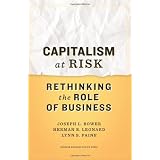
Capitalism at Risk: Rethinking the Role of Business ReviewIn "Capitalism at Risk", three Harvard Business School (HBS) professors build on the views of eminent corporate leaders around the world to sound an alarm about threats to capitalism and call on business leaders to act to preserve it. In doing so, the authors -- Joseph L. Bower, Herman B. Leonard, and Lynn S. Paine -- show how global capitalism is inextricably intertwined with global well-being and fuel a debate about the role of business in society that stands to engage serious thinkers in business, government, and academia for years to come.To develop an authoritative assessment of the state of global capitalism, the authors, with institutional support from HBS, conducted off-the-record discussions with 46 business leaders, including regional and global icons, in four "forums" held in Asia, Latin America, Europe, and the United States. Working from World Bank forecasts through 2030, the participants identified a set of specific "disruptors" -- phenomena such as protectionism, environmental degradation, unlawfulness, and gross inequalities in living standards - that could derail economic progress.
The authors quote these leaders extensively to forcefully convey the problem. For example, one participant points to widespread distrust of business: "... you cannot achieve a sense of legitimacy ... if large numbers of people think that the system doesn't work for them or is unjust to them." Another laments the absence of a level global playing field: "... we are confronted with the competition coming from countries who are not playing with the same kind of rules. So we play chess, and they play baseball with no ball and just a bat." Another faults an out-dated oversight regime: "... today's multilateral institutions which have been set up some fifty years or more ago are really set up for a totally different world versus the one we have today."
To make sense of global capitalism's plight and anchor a compelling case for action, the authors introduce a model - a global "ecosystem" -- in which society, capitalism, and other forces interact. It's a useful model, and the authors use it to drive home the fact that the success of market capitalism depends on hospitable conditions in society -- qualities such as the rule of law, the availability of labor and natural resources, and the confidence of the public. The model also illuminates their most fundamental and consequential insight -- that the global ecosystem has no overseer to guide its evolution. (Even Adam Smith, the book notes, believed that markets require some externally imposed order.) As the ecosystem potentially heads off the rails, they argue, business should act out of "enlightened self-interest" to ensure that capitalism serves society; altruism need not have anything to do with it.
So what should business do to set things right? The authors point first to bolder initiatives to tackle societal problems as profit-making opportunities; for example, using internet and cell phone technology to extend capitalism's benefits to remote geographic areas. They cite successful ventures as thought starters for corporations and entrepreneurs.
The truly big idea of "Capitalism at Risk", however, is that business leaders must move beyond simply practicing capitalism and become its stewards, working to enhance the sustainability of the market system. The idea is to rewrite the rules to bias profit-making firms toward actions that improve the system's performance for society. To do it, the authors call on business leaders to come together to more forcefully influence the institutions that set the context and make the rules - government, law, academia, and so on. As difficult - and even, perhaps, radical -- as this approach may be, the authors see no alternative. In a pithy statement in closing, they put it this way: "Calling it `the market' does not change the observation that it is on a collision course with itself."
"Capitalism at Risk" is informative, insightful, provocative, sometimes inspirational, and consistently action-oriented. It lays a fresh foundation for serious thinking about the conduct of global business and may well signal a turn to a new brand of global capitalism. It should be read by all who care about the future of the global economy, and certainly by those who seek to influence it.
Capitalism at Risk: Rethinking the Role of Business Overview
Want to learn more information about Capitalism at Risk: Rethinking the Role of Business?
>> Click Here to See All Customer Reviews & Ratings Now

0 comments:
Post a Comment