Average Reviews:

(More customer reviews)Are you looking to buy The Blame Game: How the Hidden Rules of Credit and Blame Determine Our Success or Failure? Here is the right place to find the great deals. we can offer discounts of up to 90% on The Blame Game: How the Hidden Rules of Credit and Blame Determine Our Success or Failure. Check out the link below:
>> Click Here to See Compare Prices and Get the Best Offers
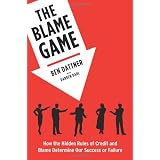
The Blame Game: How the Hidden Rules of Credit and Blame Determine Our Success or Failure ReviewConcern over who gets the credit and who get the blame is at the core of so much of our emotional angst. Chances are, if you've ever worked, you've experienced at least one of the following: your boss took credit for one of your ideas, a co-worker blamed you for something that may or may not have been your fault, you pointed a finger at someone else to deflect blame, or you sought credit that perhaps you didn't deserve.These issues of credit and blame are the topic of Ben Dattner's book, "The Blame Game, How the Hidden Rules of Credit and Blame Determine Our Success or Failure". Dattner provides an eloquent account of the impact of credit and blame in our lives, particularly as they emerge in organizational contexts.
Through a wealth of psychological research, theory, and the author's own consulting experiences as an organizational psychologist, Dr. Dattner explains the origins of credit and blame (in terms of an evolutionary perspective, family influences, and human personality), and how individuals can apply practical strategies for dealing with the blame game to organizational situations with the goal of improving overall work experiences. "The stark truth is that credit and blame matter" and "We can all benefit by learning to be more strategic about credit and blame."
In order to make the issues regarding credit and blame come alive for the reader, Dattner provides many engaging anecdotes from his own experiences as a consultant. In one memorable example, he recounts the story of two professional acrobat partners with whom he consulted who "found themselves pitted against each other" when one of them had a terrible fall during a pivotal performance when they were trying a new routine. These two partners fell victim to the blame game, pointing fingers at each other for various faults, which led to a dysfunctional business partnership. Fortunately, the author "helped them reach a `flipping point' in their relationship where they began to understand that they each brought different and valuable skills to their partnership."
While there are several stories about how the blame game plays out between individuals, such as with the aforementioned aerialists, Dr. Dattner also offers a rigorous exploration of the dynamics of credit and blame as they exist at a macro level - within organizational cultures. An example of this sort of exploration can be found in Dr. Dattner's contrasting of the cultures of American Airlines and Southwest Airlines with regard to their attitude toward blame. American Airlines employees tended to point fingers when things went wrong (such as delays) whereas Southwest employees sought to understand the problem and to not resort to blame. Much of Southwest's success can be attributed to their openness, and willingness to take responsibility for errors and mistakes. The considerable trust this approach to credit and claim engenders, is a critical component of any high performing team and company. A culture of blame can be dysfunctional because it prevents a company from learning and growing. Dattner asserts, "Whether an organization has a culture of blame or not can be a key determinant of performance at all levels."
Steering clear of a cookie cutter approach to addressing issues related to credit and blame, Dr. Dattner acknowledges that there is no "one size fits all" strategy to solving issues of credit and blame. He does, however, provide a number of useful tips for the reader to take back and apply at the office. For example, he encourages individuals to understand their own personality, the personalities of those around them, and how personality styles may influence tendencies towards credit and blame. Those familiar with the Hogan Developmental Survey, will recognize the relationship between Hogan's career derailers and Dattner's description of the different types of dysfunctional attitudes held by others in regards to credit and blame. Dattner has, in fact, developed an assessment instrument that integrates an individual's Hogan Developmental Survey profile into a credit and blame taxonomy.
Perhaps the greatest impact of this book is that it forces the reader to take a step back and reflect about his or her own behavior regarding credit and blame. If you're like me, then reading The Blame Game, will raise your awareness of your own tortured relationship with credit and blame and where you could have really added more value to your team and organization in the past. As Dattner explains, "coming to a better understanding of the dynamics of credit and blame can bring a competitive advantage both to you in your career and to the team and organization you work in."
Whether you are a CEO of a fortune 500 company, a consulting psychologist, or just beginning your first job out of college, "The Blame Game" can provide you with a sophisticated perspective on the dynamics of credit and blame. Give Dattner credit, his research and well-written historical anecdotes will leave you more knowledgeable, while his consulting tales will leave you better equipped to manage the blame game yourself, and equip you with the necessary tools to play fairly and effectively in the game itself.
The Blame Game: How the Hidden Rules of Credit and Blame Determine Our Success or Failure Overview
Want to learn more information about The Blame Game: How the Hidden Rules of Credit and Blame Determine Our Success or Failure?
>> Click Here to See All Customer Reviews & Ratings Now

0 comments:
Post a Comment