Average Reviews:

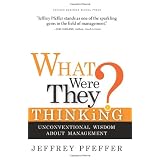
(More customer reviews)Are you looking to buy What Were They Thinking: Unconventional Wisdom About Management? Here is the right place to find the great deals. we can offer discounts of up to 90% on What Were They Thinking: Unconventional Wisdom About Management. Check out the link below:
>> Click Here to See Compare Prices and Get the Best Offers
What Were They Thinking: Unconventional Wisdom About Management ReviewJeffery Pfeffer takes the material in is recurring column in Business 2.0 and expands them into short vignettes on management and leadership topics. Normally, this approach does not work as either the book becomes a trite reiteration of previous material or the ideas that were good for a column are not robust enough for treatment in a book. Pfeffer does a superb job avoiding both as each chapter/thought is concise fully developed and warrants a couple of page treatment. A summary of each section and chapter highlights is at the end of this review. This book has the consideration and wisdom to be the true direct support managers need for managing their people, business plans, and ad hoc situations.Pfeffer's focused and comprehensive treatment provides wisdom that every manager should have access to and frequently reference. I would suggest that executives and managers use this book as a cost effective tool for management development by followng three steps:
First, I would have every manager read the book now.
Second I would make it part of your planning process by requiring managers to re-read the book prior to doing their plans and budgets for 2008.
Finally, I would make sure the book is used in executive and corporate governance processes when many of the suboptimal decisions Pfeffer discusses get made. In that way executives will be informed and make a business decision rather than one that 'makes the numbers work'.
The book is good, but there are a few weak spots. Pfeffer is a world renowned organizational design and Human Capital expert and this shows in the book. The book can be a little people heavy to the exclusion of other considerations such as strategic, market, financial etc. Pfeffer raises issues of corporatepolicy issues that are often outside the power of individual managers to change. Pfeffer addresses this issue in Chapter 20 - No more excuses so I would recommend reading chapter 20 first or at least right after the first section of the book.
Overall the book contains wisdom that every manager needs because so often we become `autistic' in business, by that I mean that we look at employees as things rather than people. This book is valuable to every manager and executive and will them keep things in balance and be a better manager.
The book is divided into the following parts and I have highlighted a few of the best chapters.
Part One People-Centered Strategies concentrates on issues related to insights into how the organization works with its people. Specific topics include:
Chapter 2 People as the face of your business -- a clear statement of the obvious but overlooked truth that people are central to the business
Chapter 3 Making companies work like communities provides human view on the issue of culture, not as an abstract concept but as the human interactions inside the company that make it tick
Chapter 5 How companies get smarter through taking chances and making mistakes providing a definition of the power of a fault-tolerant company. It reminds me that the most valuable employee is the one who has just learned from a mistake
Part Two Creating Effective Workplace provides a practicable advice on how to manage core workplace issues.
Chapter 8 Let workers work -- discusses the real but not recognized corporate impact of the trend to have employee directed benefits and programs.
Chapter 9 Why Spy on Your Employees addresses the challenging issue of monitoring employee work activities in an interconnected world.
Chapter 10 All work and no play is of particular interest as it highlights the difference between activities (I work long and hard) and results. Too many people confuse the two to the detriment of the company and themselves.
Chapter 13 Resumes don't tell covers the issue of talent selection and the information you need to get the best people.
Part Three Power Plays discusses the role of the senior executive and paths to gaining that role.
Chapter 14 The Courage to Rise Above is perhaps the most important chapter in the book for the individual manager as it contains some hard to hear, but must be heard advice on developing and advancing your career and the career of others. The wisdom in this section is tough but very valuable.
Chapter 15 Executive in Chief highlights the importance and power of leading through a process of framing, measurement and communication that everyone can use. Some leaders lead by force of will, this is a process for leading that creates leadership capability rather than demands political capital.
Chapter 20 No excuses discusses the prevalent topic of executives and managers concentrating on how things will not work, rather than how they could work. This chapter works well with the earlier chapter on persistent. No Excuses should be mandatory reading and review whenever someone says that "we can't" or we can when pigs become aerodynamically sound.
Part Four Measures of Success discusses issues of measurement and performance management. The chapters here are pretty self explanatory, solid and include
Chapter 23 Dare to be different - discussion of the evils of benchmarking
Chapter 25 Don't' believe the hype about strategy - something every manager and executive who has written a check for consultants to ghost write their strategy should read.
Part Five Facing the Nation discuses the policy implications of management and human performance issues. This section addresses issues regarding unions, executive pay and corporate responsibility.What Were They Thinking: Unconventional Wisdom About Management Overview
Want to learn more information about What Were They Thinking: Unconventional Wisdom About Management?
>> Click Here to See All Customer Reviews & Ratings Now

0 comments:
Post a Comment